contact us

Use the form on the right to contact us.

You can edit the text in this area, and change where the contact form on the right submits to, by entering edit mode using the modes on the bottom right.

Form Block
This form needs a storage option. Double-click here to edit this form, and tell us where to save form submissions in the Storage tab. Learn more
         

123 Street Avenue, City Town, 99999

(123) 555-6789

email@address.com


You can set your address, phone number, email and site description in the settings tab.
Link to read me page with more information.

Goat News

Get the latest Goat in the Road Productions news, including show announcements, community partnerships, and behind-the-scenes stories from our New Orleans theatre company.

Letter from Ukrainian Tetiana Kytsenko

Shannon Flaherty

March 15, 2024

Here is a letter provided to Goat in the Road by our Ukrainian dramaturgical consultant, Tetiana Kytsenko, as we worked on the play Top 5 Survival Moves:

My husband’s grandfather, who lived in the Bryansk region, recalled how in the 1930s people literally crawled there from Ukraine - half-dead, weak from hunger. Local women left some food for them in the bushes on the side of the road: the Russian authorities forbade helping those starved to death.

My great-aunt Antonina, while working on a collective farm, hid a handful of grain to feed her hungry younger sister at home. Because of this, she served several years under the “three ears of corn Stalin’s law” and she was never allowed to return to her hometown, where, with a criminal record, she was doomed to unemployment.

My great-uncle Minai was mobilized in WW2, sent, as we would now say, to a “meat assault” and died almost in the first battle. My great-grandmother was sent to camps because she shouted to the head of the collective farm: You made an exemption for your son, but they killed my Minochka!

My paternal grandfather was dispossessed by communists, his house, mill, and land were taken away. He and his wife fled to Adygea, where my father was born. After returning to Ukraine, they lived in poverty; my father was sent to the Suvorov Military School. There he had to switch to Russian and never again communicated in his native language in everyday life.

Perhaps you will say, all this is in the past, we must live in the present. But now Russia is using the same methods against Ukraine. In an attempt to provoke famine, the Russians are bombing our food warehouses, and last summer, Brovary, where I live, was shrouded in the stench of tens of thousands of tons of rotting chicken and fish. Residents of the occupied territories are first forced to take Russian passports, and then mobilized and sent into “meat storms:” there are now almost no men left in the Donbass and Lugansk region. Everywhere where the Russians have established their power, for the slightest disloyalty to it they are put in the pit, and then sent to camps or killed. (How many dungeons we will still find in liberated villages!) They can be evicted from their own home in the occupied territories just like that - so that there is somewhere to accommodate the military. Who then, when leaving, take from Ukrainian houses everything they can, and what they cannot spoil and break. And finally, about the language: if earlier Ukrainian was banned and made the language of the “countryside,” now the occupiers are burning books in Ukrainian. And in the village of Aleksandrovka, Kherson region, where I was at the theater laboratory in 2022, a tank stood in front of the library and shot it until it was completely destroyed.

Those who convince Ukrainians to give up territory to the enemy must understand: this is not about land, but first of all about people. 95% of Ukrainians do not want Russia on their territory.

Our democracy is said to be young, but freedom is in our blood, and it is for this that Ukrainian soldiers are now fighting. This is what our people strive for.

- Tetiana Kytsenko
Season 15 Announcement

Shannon Flaherty

November 1, 2023

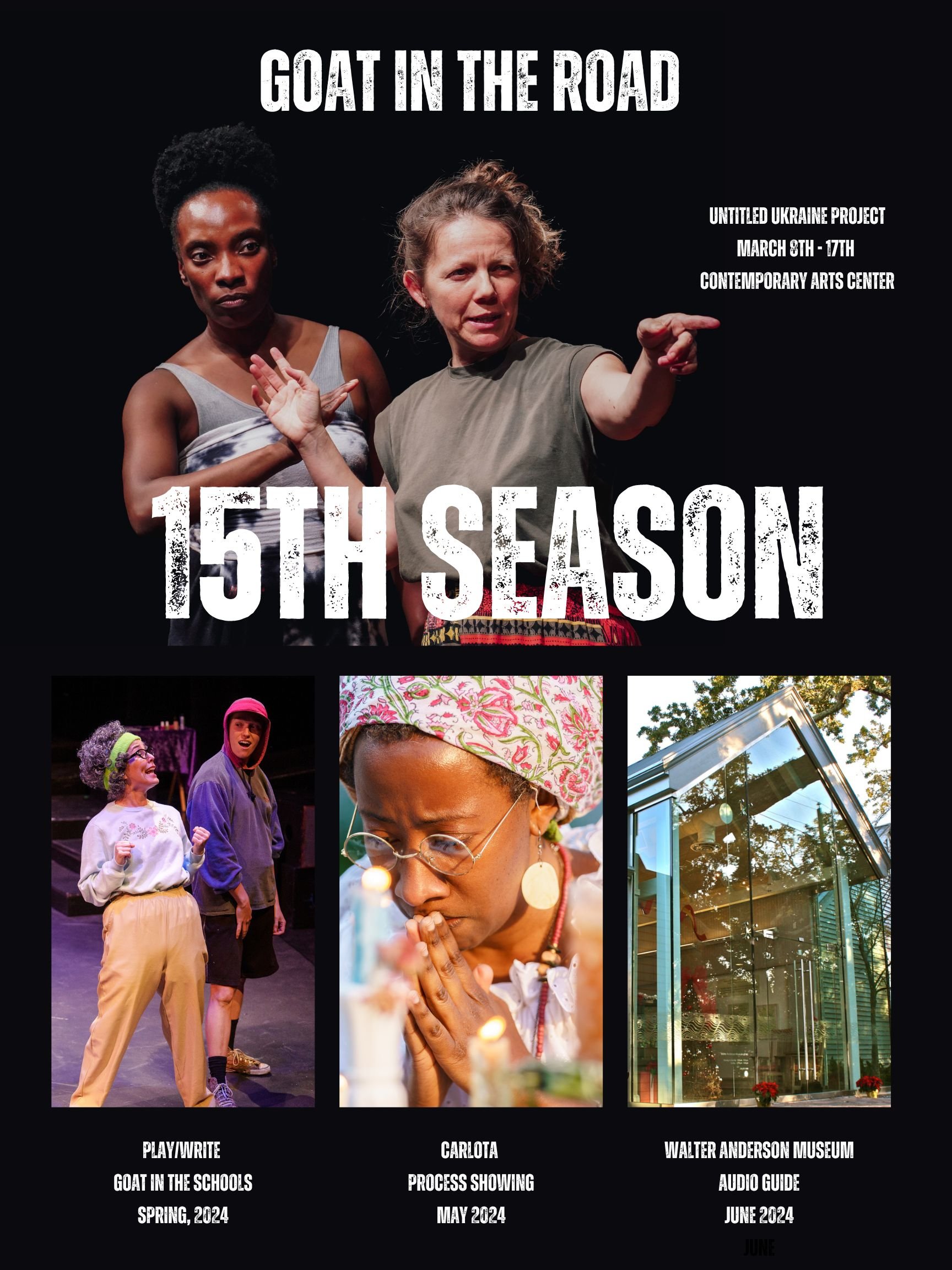
It's a little hard to believe that Goat in the Road has been around for 15 years. We started with a small crew of four artists and a barebones grant for the Play/Write program. But, with your help, our award-winning educational work is now operating in 11 schools, reaches nearly 500 students each year, and has served thousands of families in the New Orleans area. Meanwhile, we've produced over 20 original, ensemble-based shows in partnership with community organizations. Thank you for supporting us as we've figured this out bit by bit, grown in spirit, and worked to be useful to our wonderful community. 

This season includes a dynamic and eclectic mix of new work and educational programming. We're thrilled to be working with two remarkable artists in the city -- Katya Chizayeva and Dr. Denise Frazier -- on two very different projects; Untitled Ukraine Project (premiering in March at the Contemporary Arts Center) and Carlota (work-in-process showing in May).

You'll also see that we're doing a different kind of storytelling this year with our Walter Anderson Museum Audio Guide, creating a unique audio experience for museum patrons. And of course, we are bringing you our Play/Write Showcases (April and May 2024), and our touring Goat in the Schools program.

Also, check out our video celebrating this year and looking forward too:

2022 - 23, A Big Year for Goat in the Road!

Shannon Flaherty

July 2023

Summer is scorching in New Orleans, and we’re catching our breath, cleaning up the office, and reflecting on the 2022-2023 season, the company’s biggest year in history. 

Total Audience Reach: 5,000 
Play/Write Student Reach: 500
Goat in the Schools Reach: 1,700

  • In August 2022, we hosted our 13th annual Play/Write Showcase at the University of New Orleans (UNO). This two day event, rescheduled from May 2022 (thanks COVID!), presented 16 plays written by New Orleans students, performed by local theater companies.

  • In October 2022 we opened The Family Line, our newest immersive historical play set at the BK House, which ran for 13 weeks. The play, which was about the 1892 General Strike, was a huge success with sold out houses, over 2,000 people attending. In addition, The Family Line won two Big Easy Awards: one for Best Play and one for Best Director(s) - co-directors Richon May Wallace and Chris Kaminstein!

  • In February 2023, we remounted Roleplay in collaboration with Tulane University students and staff. Roleplay examines sexual violence and campus culture at the University, and reached 800 students.

  • From February - April 2023 GRP’s touring youth show, Goat in the Schools, visited 11 schools, had two public performances, and was enjoyed by over 1,700 audience members. 

This spring we hosted two Play/Write Showcases:

  • April 19: our first ever Showcase in St. Bernard Parish at Nunez Community College. Eight student plays were brought to life by Goat in the Road, the Coffee House Players, and Prescription Joy.

  • May 15 & 16: our 14th annual Play/Write Showcase at UNO, a two day affair that presented 16 student plays.

  • In addition, we added 11 new ensemble members and four new board members as we continue to grow the Goat family!


    Thank you to all who made this season a huge success!

The Curtain Closes (for now)

Shannon Flaherty

February 17, 2023

Running two shows at the same time is a first for us Goats. 

On Sunday, January 29th The Family Line closed its 3-month run, just as Roleplay was in the midst of its second performance.  We’ve spent these past two weeks striking both sets, putting props back in storage, sweeping the floors, and catching our breath.  And we want to THANK YOU. 

If you came out for either show or both, we thank you.
If you sent us supportive emails and comments, we thank you.
If you just watched from afar and enjoyed the view, we thank you. 
We could not do this work without our amazing community. 

Roleplay finished its eight-show run on February 5th for raucous Tulane crowds, and featured a remarkable ensemble of Tulane student actors. The cast brought to life the struggles and joys of campus life at this particular moment in time; examining sex, gender, consent, and anxiety in ways that were funny, sharp, and deeply relevant. We could not be more proud of this show, and these students.  

Meanwhile, The Family Line was the most successful show Goat in the Road has ever done, with rave reviews and dozens of sold-out nights (we sold out 95% of our houses). If you want to see some of those raves you can check them out here, here, or here.  More than that, the show felt like a succinct expression of where Goat in the Road stands, as a company, at this moment. It brought together a deeply thoughtful group of artists, it focused on an under-told piece of New Orleans history, and it (hopefully) did that in a way that was funny, dynamic, and magical. 

And we won’t stop here. Our ambition is to run this type of immersive work year-round in New Orleans, becoming a more permanent part of the cultural landscape. If you want to help bring that ambition to life, then reach out to us!  We need:

- Ideas for potential spaces
- Ideas for potential funding sources (private and public)
- General enthusiasm!

It’s been a thrilling year for us, with more to come. This spring we have a variety of events from our Play/Write and Goat in the Schools programs.  Here’s a little sneak peek:

--> Saturday, March 4th: ‘Goat in the Schools’ public performance.
--> Friday, March 17th: Goat in the Road’s BINGO NIGHT!
--> April 19th: Play/Write Showcase – St. Bernard edition
--> May 16th and 17th: Play/Write Showcase – Orleans edition

We can’t wait for the rest of this year. 
Have a wonderful Carnival, and see you on the other side!

Sincerely, 
Chris Kaminstein and Shannon Flaherty
(Co-Artistic Directors)

January 6th, 2021

Shannon Flaherty

More and more of Goat in the Road’s work is looking to the past for lessons in our present.  The last two immersive shows we’ve done have been about Reconstruction-era New Orleans, a time that resonates deeply with this current moment in our country. Reverend William J. Barber says we are living through a ‘third Reconstruction’ (thinkprogress.org, December 2016); a time when our nation is making the moral decisions about who will be involved in our democracy.

Henry Louis Gates Jr., in his excellent history of the Reconstruction-era Stony the Road, says this: “I’d venture that few American historical periods are more relevant to understanding our contemporary racial politics than Reconstruction.  Think of the fundamental questions the study of the period forces us to consider: Who is entitled to citizenship? Who should have the right to vote? What is the government’s responsibility in dealing with terrorism? What is the relationship between political and economic democracy?  These are all Reconstruction questions.” 

White-led terrorism was the biggest threat to democracy at the time, and is still our biggest threat. The mob that stormed the capital yesterday carried Confederate flags and hung nooses outside the Capitol. More than Russia or other foreign adversaries, the biggest threat to America’s democracy is white supremacy.

The link below is to an overview of the ‘Battle of Liberty Place’, which should rightly be called ‘The White Supremacist Uprising on Canal Street’.  Although the story is complex, the essence of it is this:  the White League of New Orleans pitted themselves against the Metropolitan Police Force in order to overthrow the election and establish Whites-only rule.

As story tellers, we must remember that our work for fellow citizens is through the narratives we perpetuate. Bryan Stevenson says this about the post-Civil War period, which is instructive:  “The true evil of American slavery was the narrative we created to justify it…[T}he North won the Civil War, but the South won the narrative war. There was no actual accountability. There was no reckoning.”

It's time for truth. It’s time for accountability. It’s time for reckoning. 

Link to 64 Parishes’ overview of the Battle of Liberty Place.